Tuesday, July 18, 2017

5 juillet 1962 Oran

I'm at the beginning of a project on the representation of memory across various attacks during the Algerian War and how this fits into the so-called Memory Wars. Because the testimony is scattered across many sources, I am providing links to sort through later and update as more become available.


Friday, May 22, 2015

Remembering French Algeria: Pieds-Noirs, Identity and Exile

Although silent on the blog for some time, I have been busily writing and am happy to announce the publication of my book: Remembering French Algeria: Pieds-Noirs, Identity and Exile with the University of Nebraska Press (2015).

“This is a thoughtful and thought-provoking study that contains remarkable insights. Remembering French Algeria makes an important contribution to current scholarship on postcolonial relations between France and Algeria and fills an important gap in that scholarship by focusing specifically on the oft-overlooked category of the community of Pieds-Noirs.”
—Alison Rice, author of Time Signatures: Contextualizing Contemporary Francophone Autobiographical Writing from the Maghreb

Colonized by the French in 1830, Algeria was an important French settler colony that, unlike its neighbors, endured a lengthy and brutal war for independence from 1954 to 1962. The nearly one million Pieds-Noirs (literally “black-feet”) were former French citizens of Algeria who suffered a traumatic departure from their homes and discrimination upon arrival in France. In response, the once heterogeneous group unified as a community as it struggled to maintain an identity and keep the memory of colonial Algeria alive.

Remembering French Algeria examines the written and visual re-creation of Algeria by the former French citizens of Algeria from 1962 to the present. By detailing the preservation and transmission of memory prompted by this traumatic experience, Amy L. Hubbell demonstrates how colonial identity is encountered, reworked, and sustained in Pied-Noir literature and film, with the device of repetition functioning in these literary and visual texts to create a unified and nostalgic version of the past. At the same time, however, the Pieds-Noirs’ compulsion to return compromises these efforts. Taking Albert Camus’s Le Mythe de Sisyphe and his subsequent essays on ruins as a metaphor for Pied-Noir identity, this book studies autobiographical accounts by Marie Cardinal, Jacques Derrida, Hélène Cixous, and Leïla Sebbar, as well as lesser-known Algerian-born French citizens, to analyze movement as a destabilizing and productive approach to the past.

Amy L. Hubbell is a lecturer in French at the University of Queensland. She is the coeditor (with Natalie Edwards and Ann Miller) of Textual and Visual Selves: Photography, Film, and Comic Art in French Autobiography (Nebraska, 2011) and with Névine El-Nossery coeditor of The Unspeakable: Representations of Trauma in Francophone Literature and Art (Cambridge Scholars, 2013).

Wednesday, November 14, 2012

The Missing: The Story of the Government's Silence


France 3 Rhône-Alpes has just promoted the 2012 documentary Les Disparus: Histoire d'un silence d'état in which several Pieds-Noirs whose loved ones went missing during or after the Algerian War are interviewed. The above clip gives a sense of the mental and emotional anguish of not knowing. The Documentary is set to air on 17 November on France 3, but you can watch the entire film by Cyrille Perez and Gilles Perez at  http://provence-alpes.france3.fr/emissions/doc-24-provence-alpes/actu/les-disparus-histoire-d-un-silence-d-etat.html

Sunday, September 16, 2012

6eme Salon du Savoir-Faire Pied-Noir

One of the many events I missed over the summer, yet it has been captured on video. Of note: the collectors' items from Algeria.


Friday, June 29, 2012

Monument des Rapatriés, Marseille


Monument des Rapatriés (avant)

For now, just a few photos of today's inauguration of the plaque recognizing the 600,000 Français d'Algérie who arrived in Marseille 50 years ago. It is now at the bottom of the Monument des Rapatriés, on the Corniche in Marseille.

The ceremony was short, speeches moving, singing of "Les Africains" even more so. The event was briefly disturbed by a couple of cars driving by, honking and waving Algerian flags. Attendees were upset.

Jean-Claude Gaudin, Mayor of Marseille


Thursday, June 14, 2012

Upcoming commemorative events

As we come upon the fiftieth anniversary of Algerian independence and the commemoration of the exodus of the Pieds-Noirs, numerous events are in the works. One I wish I could attend, "50e anniversaire de l'exode 1962-2012 des Français et des Harkis d'Algérie" will be held at the Hôtel Atria, Nîmes 23-24 June. Among the presenters are Charly Cassan and Jean-Pierre Lledo.

In Marseille from 28-30 June, I hope to attend a few of the events scheduled for the "Commémoration à Marseille du Cinquantenaire de l'exode des Français d'Algérie." My main focus is research-oriented as I will be interviewing artists who express the unspeakable of Algeria in their work. To that end, and thanks much to Nicole Guiraud, I will be at the "Colloque sur la Transmission de la Mémoire des Français d'Algérie" (30 June-1 July) in Masseube. Follow the links for programs and registration information.

Thursday, January 26, 2012

le bateau du retour: the return vessel

One of the most startling aspects of Pied-Noir narratives is the near absence of the actual voyage away from Algeria. All eyes were fixed on Algeria as the boat slowly tugged them away. Marie Cardinal's photo-documentary book Les Pieds-Noirs, for example, ends abruptly with vague references to the departure coupled with ads for vacation in France and a photo of a large liner.

There is often a large disconnect between the process of leaving Algeria and the vessel that took them away. Certainly, their minds were elsewhere at the time - needs for lodging, the new life before them, the traumas of what had just transpired before the departure. Conditions were poor for most the Pieds-Noirs during the departure, the voyage, and upon arrival. Maybe there isn't much to remember about the relatively short voyage that would entirely change the course of their lives.

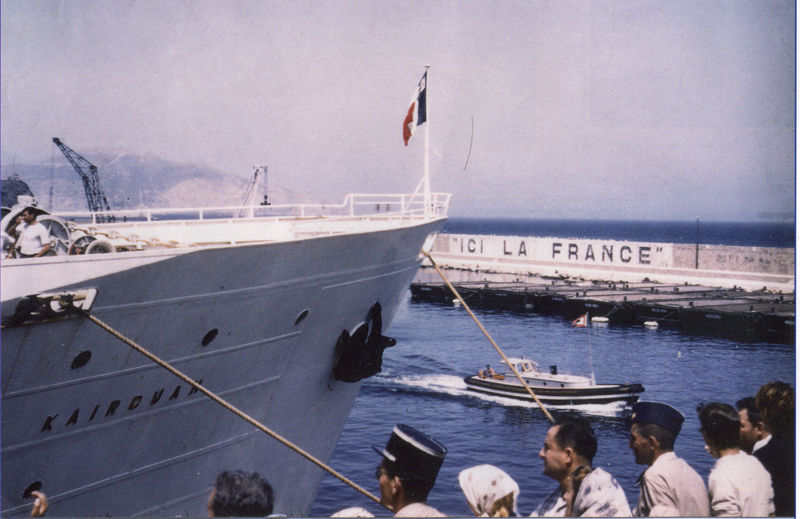
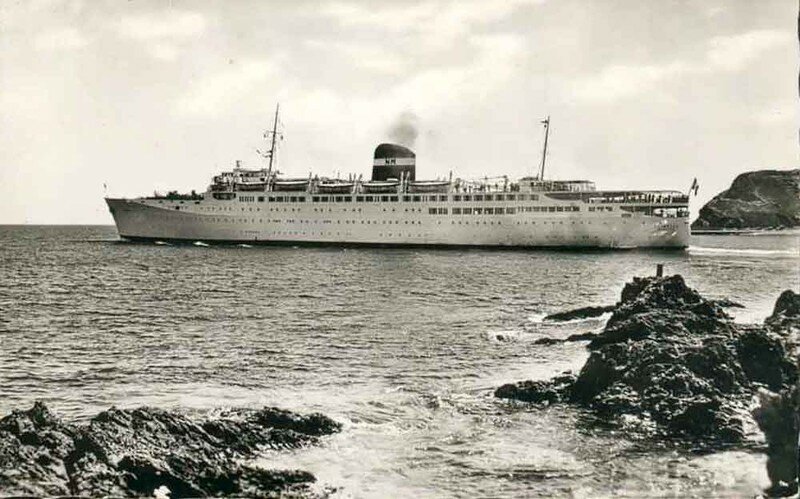
Today, however, I stumbled upon a website with a page dedicated to these ships, specifically the Kairouan. The Popodoran blog's bi-line is, "Je viens d'un pays qui n'existe plus: Oran pour ne jamais oublier..." 'I come from a country that no longer exists: Oran, so we never forget...'  Although some of the photo inscriptions recount other voyages than the exodus, one remarks, "tu m'as ramené en France quand j'avais 10 ans en 1962. Jamais je ne t'oublierais" 'you brought me back to France when I was 10 years old in 1962. I will never forget you.' The collection concludes with images of the Port d'Oran upon which was painted the inscription, "Ici la France" 'This is France.' The contributors recount the pain of their departure.

Sunday, January 15, 2012

CDHA collecting testimonials

The Centre de Documentation Historique sur l'Algérie (CDHA) in Aix-en-Provence contacted me last week with the following call for participation (my translation follows):

Nous avons un groupe « témoignages » (Histoire de Paroles) qui enregistre les récits de la vie quotidienne en Algérie, de l’exode et de l’accueil en France et dans les différents pays d’ailleurs. Si dans votre entourage des Français d’Algérie veulent également raconter leurs souvenirs, leur vécu, leurs émotions afin que leur mémoire, leur histoire  soit conservée et transmise aux générations futures, pouvez-vous leur demander de prendre contact avec nous.

We have a group "témoignages" 'testimonials' (Histoire de Paroles) that is recording stories of daily life in Algeria, of the exodus and the welcome in France and in various other countries. If there are Français d'Algérie you know who would like to talk about their memories, what they lived, and their emotions so that their memory and their history can be preserved and transmitted to future generations, could you please ask them to contact us?
If you would like to participate, please contact the CDHA directly at contact@cdha.fr. This promises to be a useful resource for those of us researching the Pied-Noir community and memory.


Tuesday, December 20, 2011

Quand la Madelon

One of the blogs I follow, Manifestation Pieds Noirs 2012 blog, wrote a piece on 4 December that plunged me into the minutiae of Pied-Noir history. In their article "La Madelon était pied-noire," the author contends that the heroine of the World War I song, "Quand la Madelon" was from Batna, Algeria.

According to Wikipedia.fr, the singer Bach (Charles-Joseph Pasquier) created it in Paris in 1914. The words were written by Louis Bousquet (1870-1941) and the music by Camille Robert who was born in Batna in 1878.

The song was not immediately popular. According to Manifestation who cite the following letter from Jean Bayol printed in the Algérianiste (number 3, 15 June 1985, pp. 71-72, my translation): 
"I possess numerous documents and testimonies of great interest. Four years ago while following the roots of 'La Madelon,' I was able to go back to her father's birth.
Several Madeleines were born between 1873 and 1876 in Batna (because Batna is his birth town), (for example, Jeanne Madeleine Bretin born January 6, 1875 to Annette Bretin and an unknown father.)
It would have been too easy to pick whichever Madeleine among them.
But the information that I obtained from various sources allowed me to go back to her father.
We can thus respond to Monsieur Robert that Madelon was born in Batna and that it's there that Luis Bousquet [sic], who was originally from Perrignargues (Manifestation interjects -  Parignargues, a town in the Gard) knew her and that it's in memory of her that he wrote this song.
The author of the song was not a soldier from Algeria.
He was in the 3rd division of Zouaves from Constantine.
When the three supplementary bataillons were created, he was moved to the 6th bataillon in Batna.
He says it himself, "I wrote this song in memory of a girl I met in Batna."

original text:
« Je possède de nombreux documents et témoignages d'un grand intérêt. Il y a 4 ans que je suis "La Madelon" à la trace et j'ai pu remonter jusqu'à la naissance de son père. Plusieurs Madeleine sont nées entre 1873 et 1876 à Batna (car Batna est bien son lieu de naissance), (par exemple Jeanne Madeleine Bretin née le 6 janvier 1875 de Annette Bretin et de père inconnu.) Il était trop facile de choisir parmi elles une quelconque Madeleine. Mais les renseignements que j'ai obtenus de sources diverses m'ont permis de remonter jusqu'à son père. C'est en me renseignant à la mairie que j'ai retrouvé celui qui allait devenir le père de Madeleine. Nous pouvons donc répondre à M. Robert que Madelon est née à Batna, que c'est là que Luis Bousquet originaire de Perrignargues (c’est Parignargues, village du Gard) l'a connue et que c'est en souvenir d'elle qu'il a écrit sa chanson. L'auteur de cette chanson n'est pas un militaire originaire d'Algérie. Il s'était engagé au 3ème Zouaves de Constantine. A la création de 3 bataillons supplémentaires, il fut affecté au 6ème bataillon à Batna. Il le dit lui-même : « J'ai écrit cette chanson en souvenir d'une fille que j'ai connue à Batna. » 
Why does any of this matter to me? I have been working on a book chapter entitled "Fixing the Past: Marie Cardinal's La Mule de corbillard" which analyzes the 1963 novel as an attempt to stop time for the Pieds-Noirs. While Cardinal is extraordinarily careful not to reveal the location of the novel, there are numerous hints at Algeria. The main character, Madeleine, lives alone on five hectares of land and hosts a French engineer named Pierre Landrieux. The two fall in love and begin to build a life together, but when her lover suddenly disappears, Madeleine (nicknamed Madelon by Pierre) begins the obsessive construction of a model cathedral. When World War II begins, Madeline loses control of her vineyards and begins a long spiral into vengeance, old age, and reconstructing memories.

The song's origins anchor La Mule de corbillard further to Algeria while the lyrics tell a similar tale to the love between Pierre and Madeleine:
Pour le repos, le plaisir du militaire, 
Il est là-bas à deux pas de la forêt 
Une maison aux murs tout couverts de lierre 
"Aux Tourlourous" c'est le nom du cabaret. 
La servante est jeune et gentille, 
Légère comme un papillon. 
Comme son vin son œil pétille, 
Nous l'appelons la Madelon 
Nous en rêvons la nuit, nous y pensons le jour, 
Ce n'est que Madelon mais pour nous c'est l'amour 
{Refrain:} 
Quand Madelon vient nous servir à boire 
Sous la tonnelle on frôle son jupon 
Et chacun lui raconte une histoire 
Une histoire à sa façon 
La Madelon pour nous n'est pas sévère 
Quand on lui prend la taille ou le menton 
Elle rit, c'est tout le mal qu'elle sait faire 
Madelon, Madelon, Madelon ! 
Nous avons tous au pays une payse 
Qui nous attend et que l'on épousera 
Mais elle est loin, bien trop loin pour qu'on lui dise 
Ce qu'on fera quand la classe rentrera 
En comptant les jours on soupire 
Et quand le temps nous semble long 
Tout ce qu'on ne peut pas lui dire 
On va le dire à Madelon 
On l'embrasse dans les coins. Elle dit "veux-tu finir..." 
On s'figure que c'est l'autre, ça nous fait bien plaisir.  
{au Refrain}
Un caporal en képi de fantaisie 
S'en fut trouver Madelon un beau matin 
Et, fou d'amour, lui dit qu'elle était jolie 
Et qu'il venait pour lui demander sa main 
La Madelon, pas bête, en somme, 
Lui répondit en souriant : 
Et pourquoi prendrais-je un seul homme 
Quand j'aime tout un régiment ? 
Tes amis vont venir. Tu n'auras pas ma main 
J'en ai bien trop besoin pour leur verser du vin  
{au Refrain}

Monday, December 12, 2011

Lledo's Algerias, my phantoms

Jean-Pierre Lledo sent me all of his films on DVD in 2007 after a Pied-Noir writer, Marie-Claude San Juan put us in contact. I had been trying to get a copy of Algéries, mes fantômes (2003) for years but couldn't get it shipped to the States. I finally (shamefully only) finished watching it today.

Yvette Teurlait remembering the massacre of 17 October 1961
Lledo's search for his own ghosts of Algeria in France began in 1998 on March 19 at the commemoration of the end of the Algerian war. His film ends with images just after France won the World Cup in 1998. His camera lingers on two celebrating fans waving flags, one Algerian, one French. The flags intertwine and overlap. Lledo expresses in the final scenes:
"Seul un jeune de cette génération peut faire ce geste-là. Un geste qui allait rester dans la gorge de tous les nationalistes et tous les intégristes. Qu’ils étouffent ! Mes fantômes pouvaient retourner dans leur patrie. Et moi, quand retournerais-je dans la mienne ? A moins que la mienne ne soit la patrie des gens de passage."
"Only a youth of this generation could make that gesture. A gesture that would remain caught in the throats of all the nationalists and all the fundamentalists. Let them choke! My ghosts could return to their homeland. And me? When would I return to mine? Unless mine is a homeland of transients."* 
Lledo's search for his country, Algeria, where he remained until 1993, is complex and moving. His opening scene at the Port of Marseille with his daughter Naouel explaining nostalgia as a "manque" 'lack' frames Lledo's movement as he travels all around France to talk about his films on Algeria. His encounters with multiple memories of Algeria -- from soldiers who admit to having tortured during the war, to Pieds-Noirs and Algerians who suffer from their exile, to the child of Harkis who struggles to understand her father's shame -- do not evoke nostalgic reunions. They demonstrate what Fiona Barclay's Writing Postcolonial France: haunting, literature and the Maghreb (Lexington Books, 2011) affirms, "France is haunted" (xi). Algeria and the Algerian war have long haunted France and the array of those who have been touched by the two countries still struggles to put that ghost to rest, whether by returning or simply remembering the influence one has on the other.

* My translation differs from the English subtitles on the DVD.

Sunday, December 11, 2011

Interview with Marc Laffineur, "The Memory of the Algerian War must be Appeased"

Translated excerpts from the interview in La Croix with Minister of Veteran Affairs, Marc Laffineur (5 December 2011)

La Croix: Isn't it also time to work out the truth about the Algerian War?
ML: The Algerian War was a tragedy. We must have the courage to bring all aspects of this conflict to light. The vast majority of the French military were exemplary in carrying out their duty. The truth should not work in only one direction. It has to reflect all aspects, even the mistakes on both sides, and it has to be wanted from both sides of the Mediterranean. Created in October 2010 and presided by Claude Bébéar, the Foundation for the Memory of the Algerian War and the battles in Morocco and Tunisia is working towards this.

La Croix: Can France and Algeria strengthen their ties during this fiftieth anniversary?
ML: I am obviously in favor of a dispassionate exchange regarding the commemoration of the end of the Algerian War with respect to the veterans' associations on both sides of the Mediterranean. A greater connection between the two countries is desirable. The Algerian War was a huge mess. We have to admit that it's time to turn the page. What was done with Germany in terms of reconciliation should be able to happen with Algeria.

Saturday, December 10, 2011

Coordinator chosen to organize the 50th anniversary commemorations

Translated and edited from Lignes de Défense blog by Philippe Chapleau, 6 December 2011

"Next year will mark the fiftieth anniversary of the end of the Algerian war. As such, the French President has given Hubert Colin de Verdière, formerly ambassador to Algeria for two mandates, the task of coordinating the multiple initiatives related to the anniversary. Marc Laffineur, Minister of Veteren Affairs, gave this information to La Croix who published an interview with him on Monday." (Title of this interview in English: The Memory of the Algerian War Must be Appeased)

Chapleau says he had been unaware of this nomination that was made on October 23.  However, Colin de Verdière has already taken up his post at the Quay d'Orsay and is currently building his team. His appointment comes after the creation in 2010 of the Foundation for the Memory of the Algerian War and the battles in Morocco and Tunisia. This organization's mission is "to facilitate public access to archives, to support scientific research in France and abroad, and to transmit the memory of a period which has often remained unknown." Directed by Hubert Falco, the foundation also wishes to "accomplish  the important task of collecting testimonials. It will support the publication or reprinting of these works."

Wednesday, December 7, 2011

Leïla Sebbar: Voyage en Algéries autour de ma chambre

While I work on my chapter, "Leïla Sebbar's Review of Algerias Past," I've been catching up on her blog (thanks to Laura Reeck's Writerly Identities which references it), and I see she has continued her Voyage en Algéries autour de ma chambre, published in 2008. Of particular interest, Sebbar includes images of the fabled Jardin d'Essai in Algiers (see Cixous's Si près, among many other post-Algerian memory works that reference it) and a painting of another Algerian cemetery, Cimetière d’El Hamma Sidi M’Hamed, Alger by Catherine Rossi, 2010. The ruins of the past keep coming to the fore, both visually and textually.

Thursday, November 24, 2011

bibliography on pieds-noirs

No, I haven't been blogging much about the Pieds-Noirs, but I am indeed writing and editing to tidy up my manuscript over our "summer" holiday in Australia. To help those of you interested in my writing on Pied-Noir literature, I'm including a few references here. Please email me if I can provide you with any further resources.


Book in progress:
Rewriting Home: How the Pieds-Noirs Remember Algeria. This book examines the written recreation of Algeria in the literature from the Pied-Noir community from 1962 to present. Through an examination of nostalgic returns, both real and imagined, I demonstrate colonial identity as being worked through and sustained in the motion of return and in the act of repetition.
  

Book Chapters:
“Viewing the Past through a ‘Nostalgeric’ Lens: Pied-Noir Photo-documentaries” in Textual and Visual Selves: Photography, Film and Comic Art in French Autobiography. Ed. Natalie Edwards, Amy L. Hubbell and Ann Miller. Lincoln: University of Nebraska Press, 2011.

“Dual, Divided, and Doubled Selves: Three Women Writing between France and Algeria.” This “Self” which is not One: Women’s Life-Writing in French. Ed. Natalie Edwards and Christopher Hogarth. Newcastle, UK: Cambridge Scholars Publishing, 2010. 35-46.

“Returning to the Baobab fou: (Dis)integrating Roots in Ken Bugul’s and Marie Cardinal’s Autobiographies.” Emergent Perspectives on Ken Bugul: From Alternative Choices to Oppositional Practices. Ed. Jeanne-Sarah De Larquier and Ada Uzoamaka Azodo. Trenton, NJ: Africa World Press, 2009. 81-99.

“Slipping Home in Marie Cardinal’s Écoutez la mer.” Gender and Displacement: Home in Contemporary Francophone Women's Autobiography. Ed. Natalie Edwards and Christopher Hogarth. Newcastle, UK: Cambridge Scholars Publishing, 2008. 34-45.

Essays:
“Separation and Return in the Intellectual Work of the Pieds-Noirs.” International Journal of Francophone Studies. Special Issue: The African Intellectual. Guest Ed. Natalie Edwards and Christopher Hogarth. Forthcoming 2012.

“L’Algérie recurrente et l’Algérie errante dans l’écriture des Françaises d’Algérie.” L’écriture migrante au féminin: entre temporalités et spatialités multiples. Ed. Névine El-Nossery and Anna Rocca. Forthcoming.

“The Past is Present: Pied-Noir Returns to Algeria.” Ed. Jacqueline Dutton. Nottingham French Studies. Forthcoming 2012.

“(Re)turning to Ruins: Pied-Noir Visual Returns to Algeria.” Ed. Joseph McGonagle and Edward Welch. Special issue, “Visualizing the Franco-Algerian Relationship since 1954” in Modern and Contemporary France 19.2 (May 2011): 147-61.
  

“The Wounds of Algeria in Pied-Noir Autobiography.” Dalhousie French Studies 81 (Winter 2007): 59-68.

“An Amputated Elsewhere: Sustaining and Relieving the Phantom Limb of Algeria.” Life Writing 4.2 (October 2007): 247-62.


Monday, October 10, 2011

In the world of Pied-Noir Research...

Because of this blog, in the last two weeks students from two different countries have contacted me regarding research projects on the Pieds-Noirs. Poor abandoned blog. I have not quit writing about the Pieds-Noirs, and much is happening in the community as they prepare for the 50th anniversary of their exodus from Algeria. I have just been consumed with finishing my book manuscript and other projects since moving to The University of Queensland in Brisbane, Australia. My apologies for not doing a better job of keeping the blog up to date.

For the handful of readers who need English language research on the Pieds-Noirs, I intend to put up links to scholarly articles in the upcoming months. For those of you who also read French, most of the recent correspondence I've received is related to Charly Cassan's film La Valise ou le cercueil which I have not yet seen. You can follow the promotion on Facebook through multiple groups as the producers try to get the film onto France's national television stations. Video clips are available here (photo and link sent to me by Reportage 34).

I have been actively blogging elsewhere on the much more personal but somewhat related subject of hoarding at http://hoardingmemory.wordpress.com but my research on the Pieds-Noirs is ongoing. If you have questions, comments, or research ideas, please feel free to contact me.

Sunday, July 3, 2011

Repatriating Remains from Algeria

According to Ennahar Online today, 135 small French cemeteries in Algeria will be regrouped into 22 cemeteries in Algerian cities. There were 523 cemeteries and 210,000 graves gradually abandoned after Algerian Independence.

The Pieds-Noirs who make pilgrimages back to their hometowns often go to the cemeteries to find ancestral graves. The graves that are now in ruins evoke extreme emotion from the Pieds-Noirs who feel helpless to stop the desecration of the abandoned sites. For many who have revisited Algeria, the cemeteries are the penultimate sites of return (see Marie Cardinal's Les Pieds-Noirs and Au pays de mes racines, Hélène Cixous's Si près, and Jacques Derrida and Safaa Fathy's Tourner les mots).

The decree to regroup the graves apparently also gives French citizens the option of repatriating the remains of their loved ones at their own expense. An interesting choice: let the loved one remain "abandoned" in their homeland, or have them join their families in exile so they can be looked after. Of course, cemeteries are not as much for the dead as for the living.

Monday, June 13, 2011

Pèlerinage recap

Indeed, I was in Nîmes for Ascension again this year, but under the rain and grey skies, the event took on a different tone. I apologize to those I was supposed to meet. I looked, asked around, and texted, but did not find them. Instead, I met a few new characters in the street and at their booths, and I believe they provided me with enough material in just a few minutes of conversation to help me find my way to the end of my book.

I can't tell if it's apparent here, but I'm struggling with my experience in Nîmes this year. I predict that next year's gathering which will mark the 50th year of exile will be a different sort of celebration, but somehow seeing all these aging people, some crippled, make their way up the long path to the sanctuary under the rain -- it troubled me this year. In 2007 my experience was joyful and I was treated to open strangers who happily shared their pasts with me. This year I felt distant ... what was I doing there by myself? People still openly talked with me when I approached them. I was still led around by my elbow and introduced to relevant figures in the community, but this year I was approaching a community that is slowly becoming a part of my own past. My research interests are shifting and maybe revisiting Nîmes was suddenly a personal effort to return to my own past.

Saturday, June 4, 2011

Pieds-Noirs in Nice today

I can't be there tonight to hear Jean Monneret and other well known Pieds-Noirs talk about various aspects of their history and culture (as well as that of the Harkis), so I'm reprinting a story about last year's event posted in The Riviera Times (who knew such a paper existed?).

* * *
Pied-Noir festival: a fun event with a serious undertone


Last year, 40,000 people turned out for Aux Soleil de Deux Rives, a figure that easily surpassed the expectations of the event’s organisers. Clearly a raging success, it comes as no surprise that one year later another festival is set to take place and this weekend the second annual Pied-noir festival will be held in the Arenez de Cimiez gardens.
The festival is dedicated to the Pied-noirs (French nationals who moved to Algeria when it was a colony but were expatriated after it achieved independence) and the Harkies (Algerian nationals who fought for France during the war of independence and had to flee after the war was lost). Both minority groups have endured a difficult history and experienced discrimination and alienation from the Algerian and French communities.
With music, food, games, exhibitions, films and a puppet show Aux Soleil de Deux Rives provides entertainment for adults and children. Robert Castel, an Algerian-born French film star and comedian, will be one of the highlights of the event, performing a one-man show on Saturday at 6.00pm (in French). Following the laughs will be an animated dance accompanied by the Thierry Noll orchestra.
Although plenty of fun is to be had, the festival will also shine a light on the more serious subject of expatriation and immigration, bringing together those who fled North Africa almost 50 years ago with those who are fleeing the region now…NM